
Artificial grass
BMS Building installs artificial grass across Watford, St Albans, Hemel Hempstead and Harrow. The groundwork under the grass decides whether it stays flat and drains, so that is where the work goes, and Perry Niven quotes every job himself after a site visit.
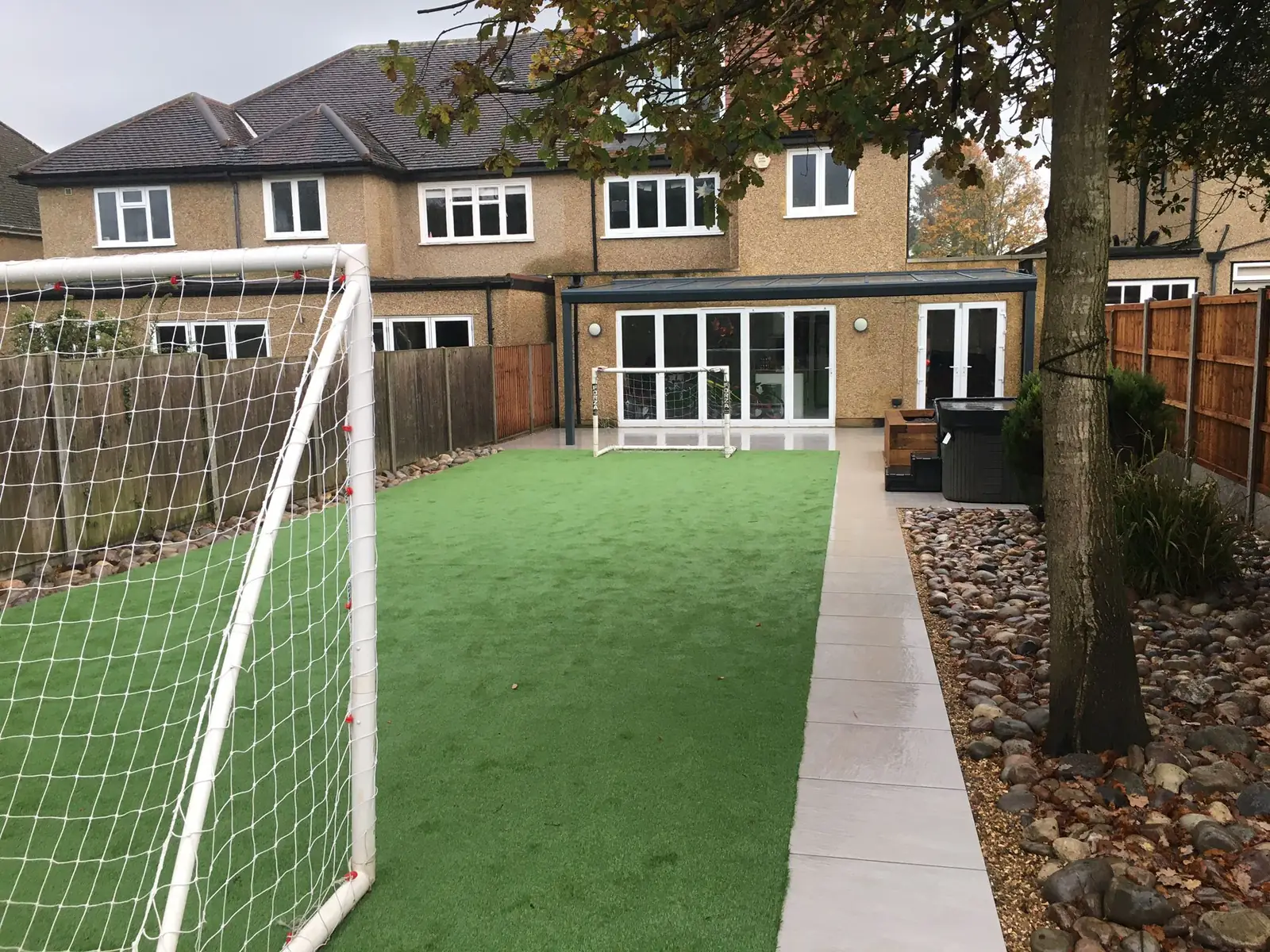
Artificial grass is sold as a product and it fails as groundwork. The roll you choose is the part you look at; what happens underneath it is what decides whether the lawn is still flat and still draining in a few years.
That is the whole of this page. Anyone can supply the grass, and the brand is your choice. The job is the excavation, the sub-base and the edges.
BMS Building installs artificial grass across Watford, St Albans, Hemel Hempstead and Harrow, and works more widely across Hertfordshire and the northwest London border, including Borehamwood, Rickmansworth and Bushey.
What goes in underneath
Every layer below does a specific job, and skipping one shows up later in a specific way.
- Excavation. The existing lawn or surface comes out, along with enough ground below it to make room for the build up. Grass laid on top of an old lawn to save the dig is the single most common shortcut, and it is why some installations are lumpy within a year: the organic material underneath keeps breaking down and the ground keeps moving.
- A compacted sub-base. Crushed stone, laid and compacted in layers. This is the structural layer and it is what holds the surface flat. Compacting in layers rather than all at once is the part that gets skipped, and a sub-base that was not compacted properly settles unevenly under foot traffic.
- Drainage. The build up has to let water through and the ground below has to be able to take it, or there has to be somewhere else for it to go. Perforated grass over a surface that does not drain is a puddle with a lid on it.
- A levelling layer of sharp sand or granite dust, screeded flat over the sub-base. This is what the grass actually sits on, and every imperfection in it telegraphs straight through to the finished surface. It is the difference between a lawn that reads as a lawn and one that reads as a carpet over rubble.
- A weed membrane, so nothing comes up through from below.
- Edges. The perimeter has to be fixed down to something solid. Unrestrained edges lift, curl and catch, and an edge that has started to lift does not settle back down on its own.
- Joins, where the area is wider than a single roll. A join is the most visible thing on a finished artificial lawn if it is done badly: the pile on both sides has to run the same way and the seam has to be closed and secured so it does not open as the material moves with temperature.
- Infill, where it is used. Brushed into the pile to weigh the surface down, help the blades stand up and keep the lawn feeling underfoot like a surface rather than a sheet.
For homes with pets, an odour control layer goes in as well.
The specification is set at the site visit, because the depths and the build up depend on the ground, the size of the area, how it drains now and how it will be used. Numbers quoted before anyone has seen the site are numbers for a different garden.
Where it works, and where it does not
Artificial grass is at its best where real grass struggles:
- Deep shade, under trees or beside a north-facing wall, where turf thins out and goes to moss.
- Small gardens taking heavy use, where a lawn never gets a rest long enough to recover.
- Awkward shapes and slopes where getting a mower in is the reason the lawn looks the way it does.
- Anywhere the mowing is the problem rather than the grass.
It is a worse answer where the garden is large and open, where the lawn is doing a job for the soil and the wildlife, and where the space is in full sun and used for sitting on, because a synthetic surface in direct sun gets considerably hotter than grass does and takes time to cool once the sun moves off it.
Artificial grass or real turf
We lay both, so there is nothing to sell you here. The honest trade-offs:
Artificial grass. No mowing, no watering, no feeding, no seasonal bare patches, and it is usable straight after rain. It is green in February. Against that: it costs more to install than turf does, it gets hot in full sun, it does nothing for soil life or insects, it wears in the routes people walk most and that wear does not grow back, and at the end of its life it is a plastic product to dispose of rather than something that composts.
Real turf. Cooler underfoot, better for the soil and for wildlife, repairs itself, and it is cheaper to put down. Against that: it needs mowing through the season, it needs watering to establish and in a dry summer, it goes patchy in shade and under heavy use, and it will be muddy in winter where it is walked on.
The cost shape is the opposite way round. Artificial grass is most of its cost on day one and very little after. Turf is cheaper to lay and carries an ongoing demand on your time or somebody else's. Which of those suits you is not a question anybody can answer from a website.
Real turf, and the ground preparation it needs, is covered in the soft landscaping and turf section of the landscaping page. If the garden needs levels changing, retaining or hard landscaping as well, that is the page to start from either way.
Taking the old lawn out
Excavating for a proper build up produces a surprising volume of turf, topsoil and spoil, and all of it has to go somewhere.
BMS (trading as BMS Building & Groundworks Ltd, formerly BMS Landscaping & Paving Ltd) holds an Environment Agency waste carrier licence, number CBDU453042, so what comes off the site is carried and disposed of legally. The legal duty of care on waste, and how to check a carrier's registration yourself, is set out on the groundworks page.
What to ask an artificial grass installer
The product questions are the ones a merchant will answer. These are the ones that decide whether the lawn lasts:
- How deep are you excavating, and what is coming out? If the answer is that the grass goes over the existing lawn, ask why.
- What is the sub-base, and is it compacted in layers?
- Where does the water go? They should be able to point at it.
- How are the edges fixed?
- Where will the joins be, and which way is the pile running?
- Is there a membrane, and where does it sit in the build up?
- Who takes the old lawn away, and what is your waste carrier licence number?
Working with BMS Building
Perry Niven founded BMS Building and quotes every job himself. Over twenty years of driveways, patios, groundworks and gardens sit behind the work, which is the relevant experience here: this is a groundwork job with a surface on top.
- Vetted TrustATrader member since 7 March 2018, membership TT13412, with no missed appointments in the last six months
- Environment Agency registered waste carrier, CBDU453042, held by BMS (trading as BMS Building & Groundworks Ltd, formerly BMS Landscaping & Paving Ltd)
Pricing is open and upfront. There are no prices on this page because what an artificial lawn costs depends on the area, the ground, how much has to come out, how it drains and the grass you choose. Every quote follows a site visit. The price agreed at the start is the price at the end, and it does not change part way through the job.
Book a site visit
Tell us roughly how big the area is, what is there now, and how much sun it gets, and Perry will come and look at it.
Common questions
What actually goes under artificial grass?
In order: the old lawn or surface is dug out, a sub-base of crushed stone is laid and compacted in layers, a levelling layer of sharp sand or granite dust goes on top of that and is screeded flat, then a weed membrane, then the grass itself, fixed at the edges and joined where more than one width is needed. The sub-base is the part that decides everything. Grass laid straight onto soil follows the soil, which means it dips where the ground settles and holds water where the ground does not drain. You cannot see any of this once the job is finished, which is exactly why it is worth asking about.
Does artificial grass drain?
The grass itself is perforated, so water passes through it. Whether the lawn drains depends on what is underneath. An open, free draining build up lets water through the whole construction and away. Grass laid over compacted clay, or over an old surface that never drained, will pond no matter how well the grass is perforated, because the water has nowhere to go once it is through. Drainage is a groundwork question rather than a product question, and it is settled at the site visit.
Is artificial grass better than real turf?
Neither is better. They suit different gardens and we lay both. Artificial grass stays green and usable in shade, under trees, on a small garden that gets heavy use, and anywhere mowing is awkward, and it needs no watering or cutting. Real turf is cooler in direct sun, better for soil life and insects, repairs itself, and is a natural material rather than a plastic one at the end of its life. Artificial grass costs more to install and nothing to maintain; turf is the other way round. The honest answer depends on how the garden is used and how much shade it gets, which is a conversation rather than a rule.
What happens to the old lawn?
It leaves site legally. Taking a lawn out produces turf, topsoil and spoil, and there is usually a lot more of it than people expect once the excavation is deep enough for a proper build up. BMS (trading as BMS Building & Groundworks Ltd, formerly BMS Landscaping & Paving Ltd) holds an Environment Agency waste carrier licence, number CBDU453042, so it is carried away and disposed of properly. It is worth asking any contractor for their licence number.