
Victorian and mosaic tiled paths
BMS Building lays and restores Victorian geometric and mosaic tiled paths across Watford, St Albans, Hemel Hempstead and Harrow. Whether an original path can be saved or has to be replaced is decided on site, and Perry Niven quotes every job himself after that visit.
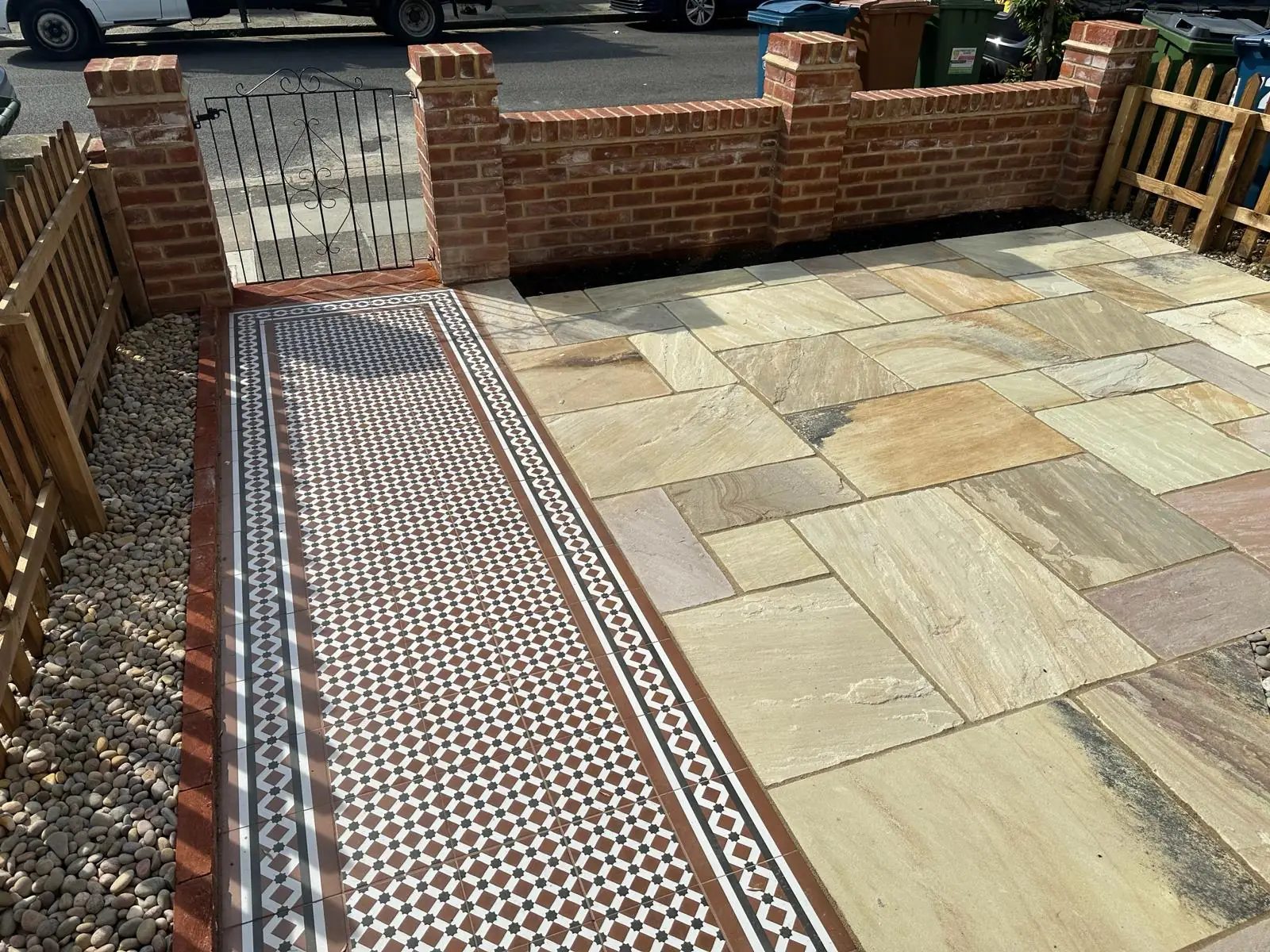
A Victorian geometric or mosaic path is the thing people notice about a house before they reach the front door, and it is usually the oldest original feature left outside it.
Most of what is written about these paths online is written to sell tiles. This page is about the work: laying a new one properly, and deciding what can be saved from an old one.
BMS Building lays and restores Victorian tiled paths across Watford, St Albans, Hemel Hempstead and Harrow, and works more widely across Hertfordshire and the northwest London border, including Borehamwood, Rickmansworth and Bushey.
Restore or replace
This is the decision the whole job turns on, and it is the reason these paths need looking at rather than describing over the phone.
Two questions decide it, and the second one decides more jobs than the first.
How much of the original tilework survives? Count what is there, not what is missing. A path with most of its tiles present, even cracked or lifted, has more to work with than one where a previous owner has patched half of it in concrete. Tiles that can be lifted whole are worth having, because an original tile is the only guaranteed match for the rest of the path.
What is the path sitting on? This is the one people do not think to ask. Tiles can be lifted, cleaned and relaid. A base that has settled, washed out or heaved cannot be repaired from the top, and relaying good tiles onto bad ground simply restarts the clock on the same failure.
Broadly:
- Most tiles present, base sound. A restoration. Lift what is loose, clean, make good and relay, replacing the missing tiles.
- Tiles in reasonable condition, base moved. A rebuild that reuses the original tiles. The path looks restored and is, structurally, new underneath.
- Little original tilework left, or a pattern that cannot be sensibly matched. A new path, which can still be laid in a traditional geometric or mosaic pattern.
Which of the three it is gets settled on site, with the path in front of both people.
Why original paths fail
These paths are typically well over a century old, and they rarely fail because the tiles wore out. Victorian floor tiles are unglazed and the colour runs through the body of the tile, which is why worn ones still look right.
They fail underneath.
Movement in the base. Whatever the path was laid on has had more than a hundred years of wet winters, dry summers and settlement. Ground washes out, settles unevenly, or lifts. The tilework is rigid and cannot follow it, so it cracks along the line of the movement.
Frost. Once there is a crack or a loose tile, water gets in. It freezes, expands, and lifts a little more each winter. A path that has been slowly deteriorating for years can lose a lot of tiles in one bad one.
Previous repairs. A patch made in hard modern cement is stiffer than what is around it. The movement does not stop, so the path simply cracks around the repair instead of through it, and the patch usually takes neighbouring original tiles with it when it eventually goes.
Lost tiles. Gates, bins, scaffolding, a skip, a previous owner deciding a path needed a step. Once a few tiles are gone the edges of the gap are exposed and the loss spreads.
Lifting, cleaning and relaying
Where tiles are being saved, the sequence matters more than the speed.
Tiles are lifted carefully rather than levered, because the aim is whole tiles rather than fast removal, and a tile broken on the way out is a tile that has to be matched later. They are kept in order where the pattern needs it, cleaned of old bedding material, and set aside sorted by colour and shape.
Old, hard cement is the slow part. It has to come off the back of each tile without taking the tile with it, and how well that goes varies tile by tile. It is one of the reasons a restoration is not a quick job, and one of the reasons nobody can price it accurately from a photograph.
Matching replacements
Geometric and mosaic tiles are still manufactured in traditional shapes, colours and sizes, so many common patterns can be matched closely.
Not all of them, and it is worth saying so. Sizes and colours varied, patterns were laid to local taste, and some combinations are simply not made any more. What can be matched for your path is established at the site visit rather than promised in advance.
This is why salvaged originals matter. A tile lifted from the path is an exact match by definition, so the ones that can be saved are usually put back in the most visible places and the new tiles used where the eye goes least.
The base
Everything above depends on this.
A tiled path is a rigid surface made of small units. It has no ability to flex, so it needs to sit on something that does not move: a sound, properly prepared base, laid to a fall so water runs off rather than sitting on the surface and finding its way into the joints.
Getting that right is the difference between a path that is still there for the next owner and one that is lifting again within a few years. It is also the invisible half of the job, which is why it is worth asking about before the work starts rather than after.
Pattern, border and edging
A Victorian path is a composition, not a surface. It has a field pattern in the middle, a border running down each side, and usually an edging that finishes the whole thing against the garden.
Rope-top edging is the traditional detail, a moulded edging tile with a twisted rope profile along the top, set on edge to contain the path and mark it off from a planted border. Other edging profiles exist and were used, and which one suits depends on the house and on what was there before.
The border is worth planning properly. It has to turn corners, meet the step or the threshold at the house, and finish at the gate, and the pattern in the middle has to be set out so it lands sensibly against it rather than running out in a half tile at one end.
Listed buildings
If your property is listed, check before any work starts.
Listed building consent is required for works to a listed building that are likely to affect its character as a building of special architectural or historical interest, and the Planning Portal is explicit that "it is a criminal offence to carry out work which needs listed building consent without obtaining it beforehand". It also recommends discussing a proposal with your local authority before applying, which it calls pre-application advice.
Whether a particular path falls within that is a question for your local planning authority rather than for a contractor. The guidance is at the Planning Portal's listed building consent page.
Waste
BMS (trading as BMS Building & Groundworks Ltd, formerly BMS Landscaping & Paving Ltd) is an Environment Agency registered waste carrier, licence number CBDU453042, so anything taken up leaves site legally. The duty of care on waste, and how to check a carrier's registration yourself, is on the groundworks page.
What to ask
- Is this a restoration or a rebuild, and why? The answer should be about the base as much as the tiles.
- What is happening underneath?
- How many original tiles do you expect to save?
- Which parts of the pattern can you match, and which cannot you?
- Where will the salvaged tiles go, and where will the new ones go?
- How is the path set out so the pattern lands properly at both ends?
- What is your waste carrier licence number?
Working with BMS Building
Perry Niven founded BMS Building and quotes every job himself. Over twenty years of driveways, patios, groundworks and gardens sit behind the work.
- Vetted TrustATrader member since 7 March 2018, membership TT13412, with no missed appointments in the last six months
- Environment Agency registered waste carrier, CBDU453042, held by BMS (trading as BMS Building & Groundworks Ltd, formerly BMS Landscaping & Paving Ltd)
A front path is often done alongside the rest of the front of the house. Where that includes a patio or paving, the patios page covers choosing those materials.
Pricing is open and upfront. There are no prices on this page, because what this work costs depends on the length of the path, how much original tilework survives, what the base turns out to be and how much can be matched. Every quote follows a site visit. The price agreed at the start is the price at the end.
Book a site visit
Photographs help a great deal with this one. Send a picture of the whole path and a close one of the pattern, and Perry will come and look at it.
Common questions
Can my original Victorian path be restored, or does it need replacing?
It depends on two things, and only one of them is the tiles. The first is how much of the original tilework survives, and how much of what is broken can be replaced with something that matches. The second, and the one that decides more jobs, is what the path is sitting on. Tiles can be lifted and relaid; a base that has moved has to be rebuilt whatever the tiles are like. A path with most of its tiles intact and a sound base is usually a restoration. A path where the ground underneath has sunk or heaved is usually a rebuild, reusing whatever tiles can be saved. That judgement is made on site with the path in front of you.
Why do original paths crack, sink or come loose?
Almost always because of movement underneath rather than a fault in the tiles. These paths are well over a century old and were laid on what was available at the time, so the base beneath them settles, washes out or heaves with frost. The tilework is rigid and cannot follow that movement, so it cracks along the line of it. Frost does the rest: once water gets into a crack or under a loose tile it freezes, expands and lifts more tiles each winter. Earlier repairs patched in hard cement often make it worse, because they are stiffer than the original and the movement simply cracks around them.
Can you match tiles to my existing path?
Sometimes, and it is worth being honest that it is not always possible. Geometric and mosaic tiles are still made in traditional shapes, colours and sizes, and many common Victorian patterns can be matched closely. Whether yours can depends on the pattern, the colours and the exact sizes used, which varied. Any tile that can be salvaged from the path itself is worth saving, because an original tile is the only guaranteed match. What can be matched is one of the things established at the site visit, before anything is committed to.
Is my path covered if the house is listed?
It may be. Listed building consent is required for works to a listed building that are likely to affect its character as a building of special architectural or historical interest, and the Planning Portal is clear that it is a criminal offence to carry out work needing consent without getting it first. Whether a path falls within that is a question for your local planning authority, not for a contractor, and the Planning Portal recommends discussing a proposal with them before applying. If your property is listed, check before any work starts.