
Block Paving in St Albans | Driveways & Permeable
BMS Building lays block paving driveways across St Albans, including permeable ranges that meet the front garden surface rule. The sub-base depth is set from what the dig finds and the edges are properly restrained, because an unrestrained edge is how block paving spreads.
Covering St Albans
Block paving in St Albans is a dig before it is a surface, and how the dig runs depends on which part of the district you are in. On the inter-war and post-war frontages there is room to work and a grab lorry can stand, so the excavation, the muck away and the delivery of blocks all happen where they need to. Nearer the centre the frontages are short or shared, several streets have daytime restrictions, and material has to be moved in from wherever the lorry can legally stop. That changes the programme rather than the price of the blocks, and it is worked out at the site visit. The other thing established on the visit is the depth: the sub-base under block paving carries the load, and the depth it needs comes from what is under the existing surface rather than from a standard figure.
Block paving driveways in St Albans
Block paving is the surface people ask for by name and the one where almost all of the cost difference between two quotes is buried out of sight.
BMS Building lays block paving driveways across St Albans and the villages around it, including permeable ranges.
The sub-base is the drive
Blocks sit on a laying course which sits on a compacted sub-base. That sub-base carries the car, not the blocks.
The British Geological Survey maps most of St Albans as chalk, with sand and gravel over much of it and clay-bearing ground in places. A build up that is right at one address can be under specified at another, so the depth comes from what the dig actually finds rather than from a standard figure.
This is the part that does not show in a photograph and is most of what separates a drive that is flat in ten years from one that is not.
Edges, and why they fail
Block paving is individual units relying on each other and on the edge course to stay interlocked.
An edge that is not properly haunched lets the whole field creep outwards. It shows first as joints opening up, then as blocks that rock underfoot. On a frontage falling towards the road, which many here do, it goes faster.
It is the most commonly skimped part of a block paved drive.
Permeable or not
Standard block paving is not permeable. Permeable ranges are, and they are laid over a different build up designed to take water through the joints and hold it in the stone below until it can soak away.
That is what allows more than five square metres of front garden hard surface without planning permission. If a quote says block paving without saying which, ask, because the two are different jobs at different prices.
A conservation area does not change that rule on its own. An Article 4 direction or a planning condition can, and two Article 4 directions apply in parts of the St Albans Conservation Area. St Albans City and District Council is the authority on your address.
Sunken in one place
Block paving lifts and relays in sections, which is a genuine advantage over a continuous surface.
But if an area has sunk because the base under it failed, relaying the same blocks on the same base repeats the problem. What is underneath gets checked first and you are told which job it actually is.
Recent work near St Albans
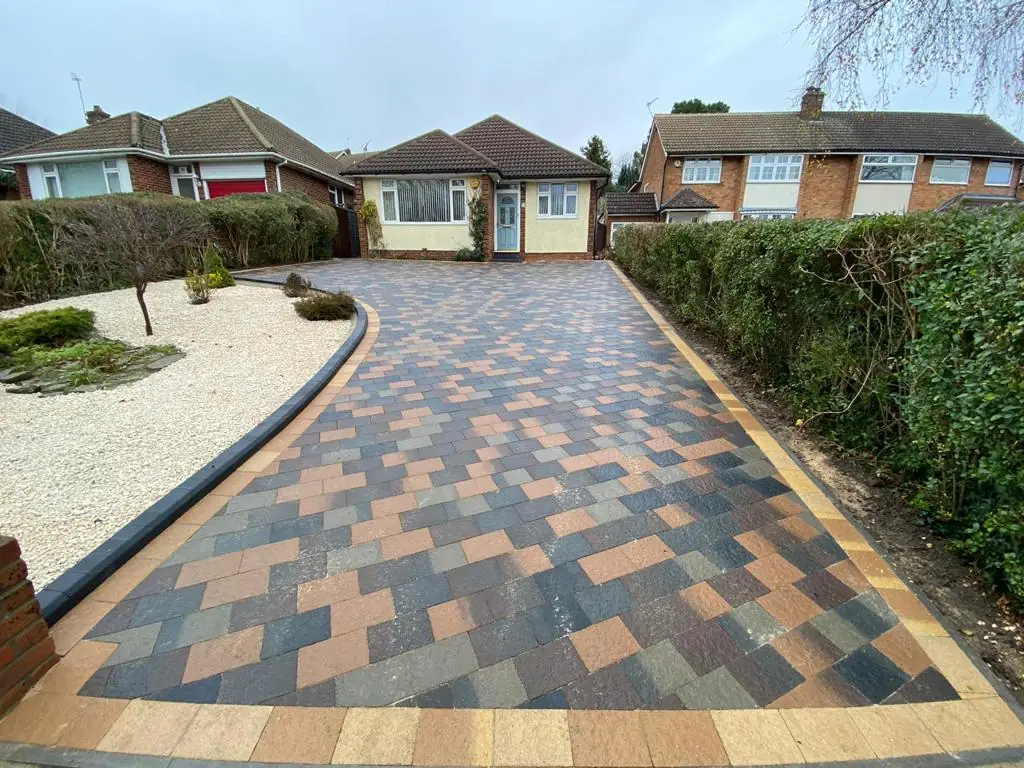
A St Albans job: a cracked concrete slab drive replaced with block paving in a multi-tone mix, with a contrasting buff border along the edge, next to a white gravel bed and the brick pier.
What St Albans properties are like
Block paving fails in two ways and St Albans supplies the conditions for both. The first is a sub-base that is too thin or badly compacted for the ground beneath it. The British Geological Survey maps most of the district as chalk, with sand and gravel over much of it and clay-bearing Lambeth Group beds in places, so a build up that is right at one address can be under specified at another. The depth is therefore measured from the dig. The second is edge restraint. Block paving is individual units relying on each other and on the edges to stay interlocked, and an edge course that is not properly haunched lets the whole field creep outwards, which shows as widening joints and then as blocks that rock. On a frontage that falls towards the road, which many here do, that creep is faster. Permeable ranges matter locally too: they let water through the joints into a stone build up, which is what allows a front garden surface over five square metres without planning permission.
St Albans questions
Is block paving permeable?
- Standard block paving is not, but permeable ranges are, and they are laid over a different build up designed to hold and release water. That is what allows a front garden hard surface of more than five square metres without planning permission. If a quote offers block paving without saying which it is, it is worth asking, because the two have different sub-bases and different prices.
Why do the edges matter so much?
- Because block paving is individual units holding each other in place. The edge course is what stops the whole field creeping outwards, and if it is not properly haunched the joints widen and then blocks start to rock. On a frontage that falls towards the road, which plenty here do, that happens faster. It is the part of a block paved drive most often skimped and least often noticed until it fails.
Can you relay just the sunken part?
- Usually, and that is one of block paving's real advantages: it lifts and relays in sections. But if the area has sunk because the sub-base under it has failed, relaying the blocks on the same base just repeats the problem. What is actually under it gets checked first, and you are told honestly which of the two jobs it is.
We also cover Radlett, Park Street, London Colney, Chiswell Green and Bricket Wood from the same base.
More about Block paving driveways