
Driveways in St Albans | Block Paving & Resin
BMS Building lays new and replacement driveways across St Albans in block paving and resin bound surfaces. The base and the drainage are designed from what is found on site, and Perry Niven prices every drive himself after a site visit.
Covering St Albans
Driveways in St Albans divide almost exactly along the age of the housing, and the site visit is mostly about working out which job it is. On the 1930s semis and the post-war streets out towards Marshalswick and Jersey Farm there is usually a proper frontage, an existing crossover and room to work, so the question is what is under the old surface and how deep it goes. Closer to the centre the Victorian and Edwardian terraces often have no vehicle access at all, and where a frontage does exist it can be short, shared, or on a street with daytime parking restrictions. That changes everything about how the job runs: where the skip or grab lorry goes, when it can come, and whether material has to be moved by barrow. It is settled on the visit rather than discovered on the first morning. BMS is based in Watford, fifteen minutes away, so a second visit for levels costs an hour rather than a day.
Driveways in St Albans
Most driveway problems in St Albans are not surface problems. A drive that has sunk in the wheel tracks, or that pools water against the house, or that has moved at the edges, is almost always telling you about what is underneath it and where the water goes. Relaying the top of it changes the colour and nothing else.
BMS Building lays new and replacement driveways across St Albans and the villages around it, in block paving and resin bound, from a base in Watford.
What decides the job here
Two things, and both are found with a spade rather than a photograph.
The first is what is under the existing surface and how deep it goes. The British Geological Survey maps most of the district as chalk, with sand and gravel over much of it and clay-bearing ground in places, so the sub-base depth is measured from what the dig finds. A standard figure applied across a whole town is how a drive on the wrong ground fails early.
The second is the fall. On the inter-war semis there is often less height between the damp proof course and the footway than people expect, so the surface has to be laid to carry water away from the wall and somewhere it can actually go. Following the old level and hoping is how a new drive puts water against brickwork.
Block paving or resin
Block paving is individual units on a compacted sub-base and a laying course, with the edges restrained. It can be lifted and relaid in sections, which matters if a service ever has to be dug up, and permeable ranges let water through the joints.
Resin bound is aggregate mixed with resin and trowelled onto a solid base. It is a continuous surface with no joints to weed, and it needs its base sound, level and cured before it goes down.
Neither is better. Which one suits depends on the base that is already there, the fall, the drainage and how you want it to look against the house. That is what the site visit is for.
Permission, and the conservation area
The national rule applies: more than five square metres of new hard surface in a front garden needs permission unless it is permeable or drains to a lawn or border.
A conservation area or a listed building does not change that rule on its own. An Article 4 direction or a planning condition can, and two Article 4 directions apply in parts of the St Albans Conservation Area, which covers the city centre. Taking down a front wall in a conservation area, or altering one at a listed building, can need its own consent.
St Albans City and District Council's District Mapping Service shows whether an address is affected, and the council is the authority on your address. We will tell you what is obvious on site. We will not tell you a drive is permitted when that is the council's call.
The older streets
Around the Abbey, Fishpool Street and much of the Victorian terracing there is often no off-street space and daytime restrictions on the road. None of that stops the work. It changes how waste leaves and how material arrives, and it is decided at the site visit rather than on the first morning.
Recent work near St Albans
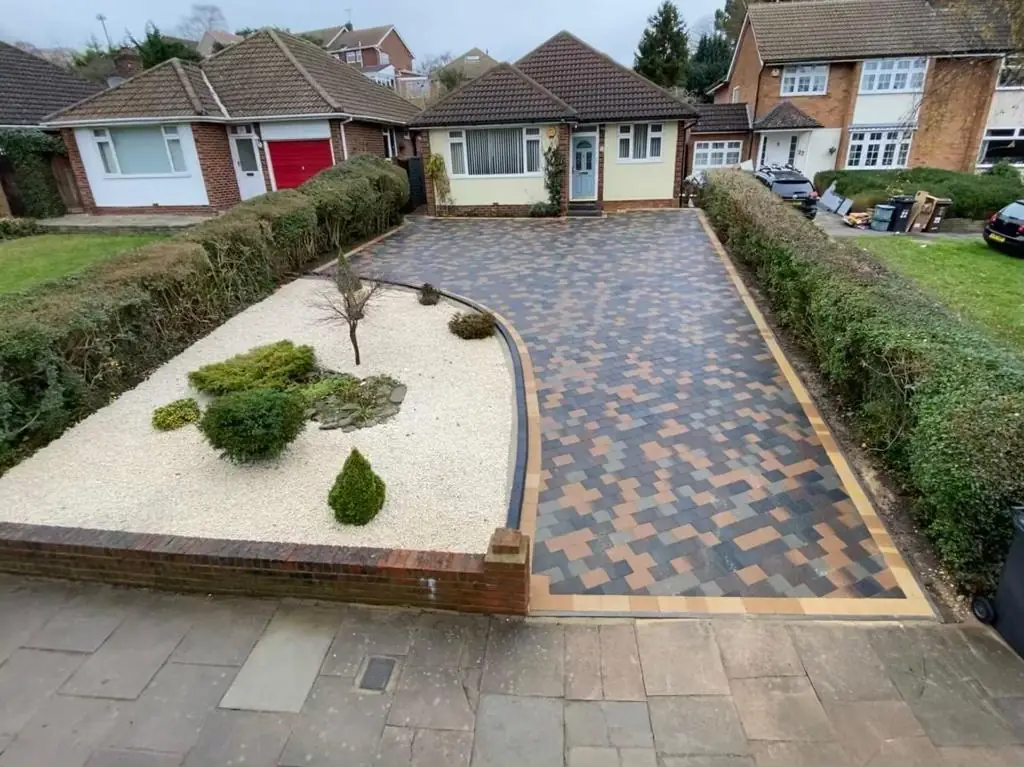
This St Albans driveway started as cracked concrete slabs. BMS Building took the old surface out and laid a multi-tone block paved drive, curving the edge where it meets the front garden and finishing beside the brick pier with a bed of white gravel.
What St Albans properties are like
The ground under a St Albans drive is the thing that decides how long it lasts, and it is not consistent across the district. The British Geological Survey maps most of the district as chalk, with sand and gravel over much of it and clay-bearing Lambeth Group beds in places, so the sub-base depth is measured from what the dig actually finds rather than taken from a standard figure. The second local factor is the age of the frontage. On the inter-war stock the existing crossover is often narrower than a modern car wants and the fall from the house to the footway can be shallow, which makes where the water goes a design decision rather than an afterthought. The third is consent. A conservation area or a listed building does not, on its own, change the front garden surface rule. An Article 4 direction or a planning condition can, and two Article 4 directions apply in parts of the St Albans Conservation Area. A listed building brings consents of its own for a front wall or railings, and in a conservation area taking a front wall down can need permission. St Albans City and District Council is the authority on a specific address.
St Albans questions
Do I need planning permission for a driveway in St Albans?
- The national rule applies across St Albans, conservation areas included: a new or replacement hard surface of more than five square metres in a front garden needs permission unless it is permeable, or unless the water runs off to a lawn or border where it can soak away. Permeable block paving and resin bound over a permeable build up both meet that. A conservation area or a listed building does not change that on its own. An Article 4 direction or a planning condition can, and two Article 4 directions apply in parts of the St Albans Conservation Area. Taking down a front wall in a conservation area, or altering one at a listed building, can need its own consent. St Albans City and District Council is the authority on your address, and it is worth checking before anything is ordered.
Can you lay a new drive over the existing one?
- Sometimes, and only after somebody has looked at what is there. Resin can go over sound, level, properly drained concrete or tarmac. Block paving needs a compacted sub-base, so an old surface usually comes up. Laying a new surface over a failing base hides the problem for a year or two and then fails in the same places.
There is nowhere to put a skip on my street. What happens?
- It gets planned around. Several of the older central streets have no off-street space and daytime restrictions on the road, so waste removal and deliveries are arranged to suit the street: timed grab lorry rather than a standing skip, material dropped and moved in, or a permit where one is needed. That is worked out at the site visit, because a lorry that cannot reach the house is a lost morning for everyone.
How long will a driveway take?
- It depends on the size, the surface, how much comes out first and what the ground turns out to be. A straightforward replacement on a sound base is short. A drive that needs digging out, new drainage and a full sub-base takes considerably longer, and resin needs its base cured before the surface goes down. The expected timescale is in writing with the quote.
We also cover Radlett, Park Street, London Colney, Chiswell Green and Bricket Wood from the same base.