
Paving in St Albans | Paths, Steps & Edging
BMS Building lays paving across St Albans: paths, steps, edging and terraces. The method is what matters, a full mortar bed rather than spot bedding, falls away from the house and clearance below the damp proof course, and it is set out at the site visit.
Covering St Albans
Paving in St Albans is often a small job in an awkward place rather than a large one in an open space, and that is what shapes it. Paths down the side of a terrace, steps where a garden falls, a run of edging holding a border: all of them need material carried in and spoil carried out by hand where there is no side access, which is common behind the central streets. The plots that fall away from the house are the other constant here, and steps between levels are the thing that turns a path into a proper job. Steps get set out on site with a level rather than estimated, because a rise that varies from step to step is both ugly and a trip hazard. BMS is based in Watford, fifteen minutes away, which keeps a short run of paving worth doing on its own rather than something that has to wait to be bundled with bigger work.
Paving in St Albans
Paving that rocks under your foot two years after it was laid is almost always telling you the same thing: it was spot bedded.
BMS Building lays paving across St Albans, from a base in Watford about fifteen minutes away. Paths, steps, edging and terraces.
Full bed, not five blobs
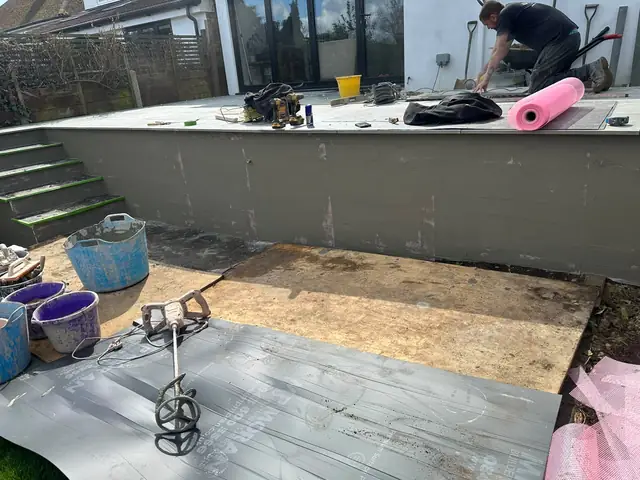
Spot bedding puts a slab on five dabs of mortar. It is quicker, it is cheaper, and it leaves most of the underside of the slab supported by nothing.
Water gets under it, frost works on it, and the slab either rocks or cracks across the unsupported middle.
A full mortar bed supports the whole slab. That is the method here, and it is worth asking whoever else quotes whether it is theirs.
Falls, and the damp proof course
Paving next to a house has to fall away from it, and it has to finish clear below the damp proof course.
On the Victorian and Edwardian stock near the centre of St Albans the DPC sits low, so that clearance is tight and it constrains the finished level before anything else is decided. Paving laid at or above the DPC bridges it and puts water into the wall.
Steps, on a garden that falls
A great many St Albans gardens drop away from the house or across it, which is why so much of the paving work here ends up being steps.
Every rise in a flight should be the same. A step that is different from the ones around it is the one people trip on. They are set out with a level on site rather than estimated, and the water is given somewhere to go off each tread.
Getting material in
Behind the central terraces there is frequently no side access, so slabs come in and spoil goes out by hand through the property.
It is normal here, it takes longer, and it is in the quote rather than added to it.
How a patio is built
The method above is the same one the patios page describes, and the choice of material is covered there rather than repeated here.
Recent work near St Albans
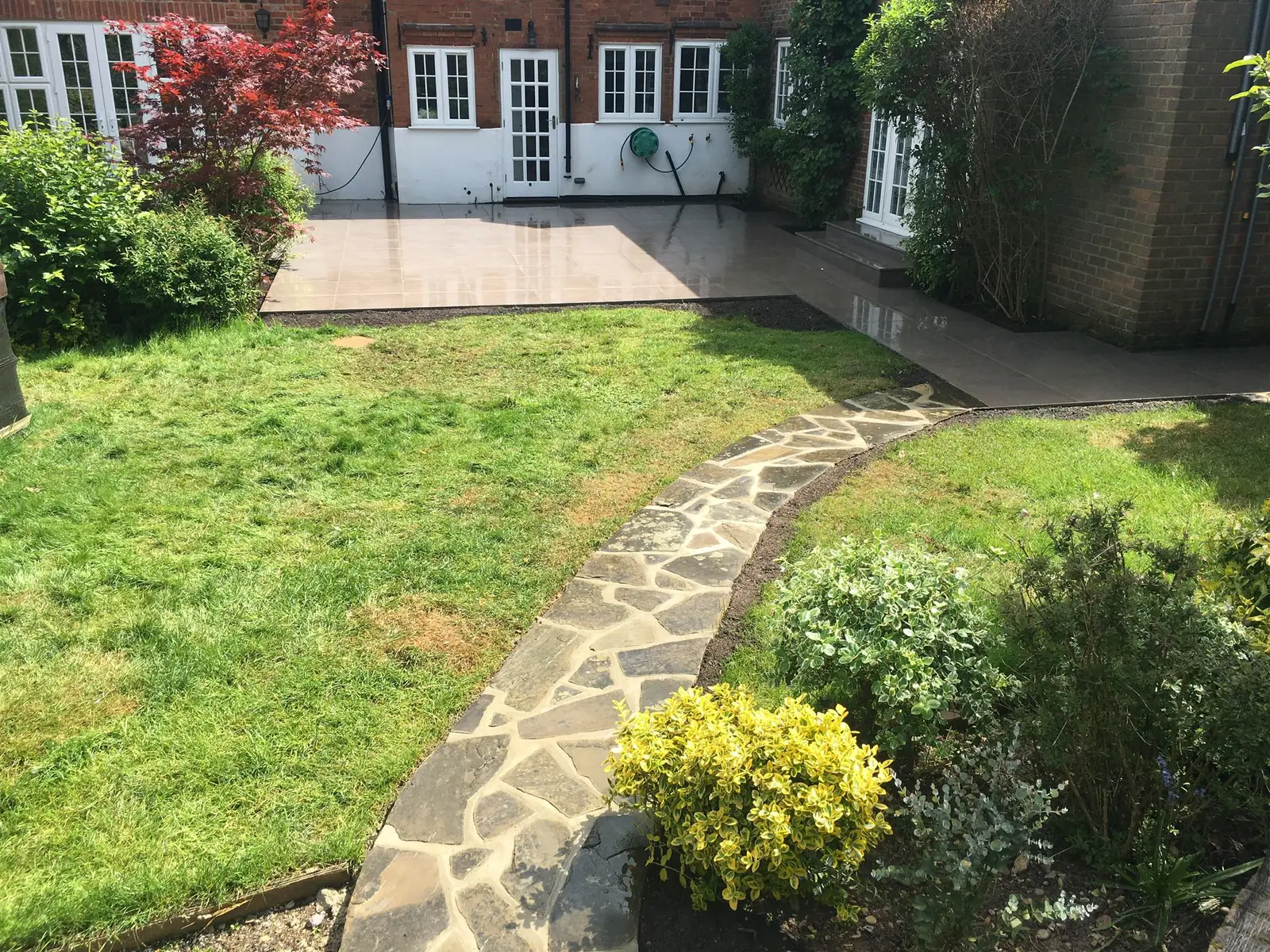
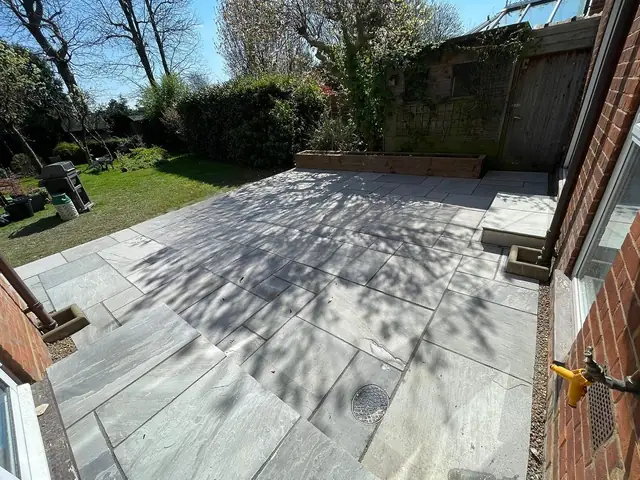
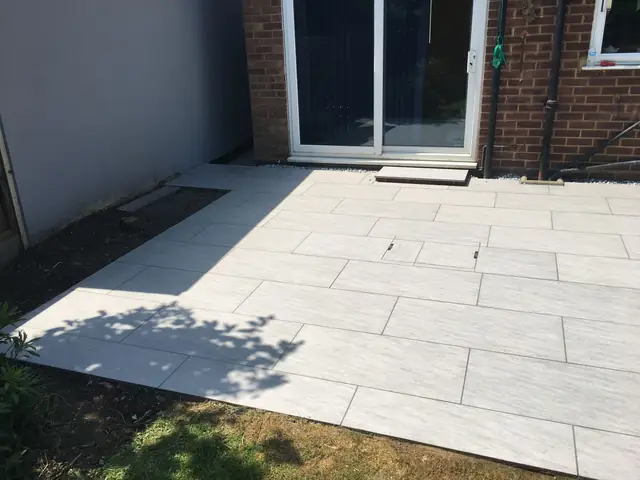
In Radlett, just south of St Albans, BMS Building laid a crazy paving path that curves across the lawn to a new porcelain terrace at the back of the house, with a porcelain path down the side of the house to match.
What St Albans properties are like
Two St Albans conditions decide paving more than the material does. The first is the fall of the plot. A great many gardens here drop away from the house or across it, so a path or a terrace is rarely a matter of laying flat: the level has to be established, the steps set out evenly, and any retained edge built to hold what is behind it. The second is the damp proof course. On the Victorian and Edwardian stock near the centre the DPC sits low, and a new paved level laid at or above it bridges the damp proof course and puts water into the wall. Clearance below the DPC is a rule rather than a preference and it constrains the finished level before anything else is decided. The ground varies too: the British Geological Survey maps most of the district as chalk, with sand and gravel over much of it and clay-bearing Lambeth Group beds in places, so the sub-base under a path is dug to what the ground shows. A conservation area does not change the rules for a path or terrace on its own, but an Article 4 direction or a planning condition can, and two Article 4 directions apply in parts of the St Albans Conservation Area.
St Albans questions
What is spot bedding and why does it matter?
- Spot bedding is laying a slab on five blobs of mortar rather than a full bed. It is quicker and cheaper and it is the single most common reason paving rocks, cracks or lets water sit under it. A full mortar bed supports the whole slab. It is what we do and it is worth asking any quote you get whether they do the same.
How close to the house can the paving come?
- Not up to the damp proof course. The finished level has to sit clear below it, or the paving bridges the DPC and moves water into the wall. On the older stock near the centre that clearance is tight, so it is measured before the levels are set and it constrains everything above it.
My garden has steps. What decides how they are built?
- Consistency, mostly. Every rise in a flight should be the same, because a step that is different from the ones around it is what people trip on. They are set out on site with a level, not estimated. The going, the rise and the drainage off each tread are all worked out before anything is laid.
We also cover Radlett, Park Street, London Colney, Chiswell Green and Bricket Wood from the same base.