
Patios in Harrow | Porcelain, Sandstone & Granite
BMS Building builds patios across Harrow and the areas around it in porcelain, Indian sandstone, natural stone and granite. On London Clay the base under the patio decides more than the material does, and both are settled at the site visit.
Covering Harrow
A patio in Harrow is usually at the end of a long narrow rear garden reached down a side passage, and that passage is the first thing measured because it decides how several tonnes of material and spoil move. Where a machine will not fit, the dig is done by hand: slower, dearer, and in the quote rather than added later. The gardens themselves are fairly consistent across the borough, which makes the design question less about the plot and more about how the space gets used, and the material question more about the house it sits against. Perry Niven works both out on site. Controlled parking zones in parts of the borough mean the delivery point and the timing are agreed with the property in advance, because a pallet of slabs that cannot be unloaded where it needs to be is a lost morning.
Patios in Harrow
The patio that has cracked across three slabs in its third winter was almost never a material problem. It was laid on clay that moved.
BMS Building builds patios across Harrow, Pinner, Northwood, Stanmore and Ruislip, from a base in Watford about half an hour away.
London Clay, and what it does to a patio
Clay shrinks in a dry summer and swells in a wet winter. Anything shallow moves with it.
A patio bedded thin, or laid on undisturbed clay, shows that within a few seasons as cracked slabs and lifted edges, and it does so whether the slabs were cheap or expensive.
The base is dug to what the ground shows and compacted in layers, on a full mortar bed rather than spot bedding. That is the part of a patio quote worth interrogating, because it is the part you cannot see afterwards.
Water, on ground that will not take it
Clay holds water. Falling a patio towards a border that is already saturated just moves the puddle a few feet.
So where the water actually leaves has to be designed: a drainage run with an outfall, or a soakaway in ground that can take it. Which one comes from the dig.
The material question
Porcelain is dense, consistent and low maintenance. Indian sandstone is warm, riven and weathers. Granite is the hardest wearing and the most stable in colour.
The full comparison of what each is like to live with is on the patios page. In Harrow the housing is consistent enough that the choice is mostly about tone against red brick and a bay frontage.
The finished level
The damp proof course on the inter-war stock sits low, and the patio has to finish clear below it. That constrains the level before the design starts, and it is measured first rather than discovered when the slabs are down.
Getting it to the back
Most of these gardens are reached down a side passage, and it is measured at the site visit. Where a machine will not fit the dig is done by hand: slower, dearer, in the quote rather than added to it.
Recent work near Harrow
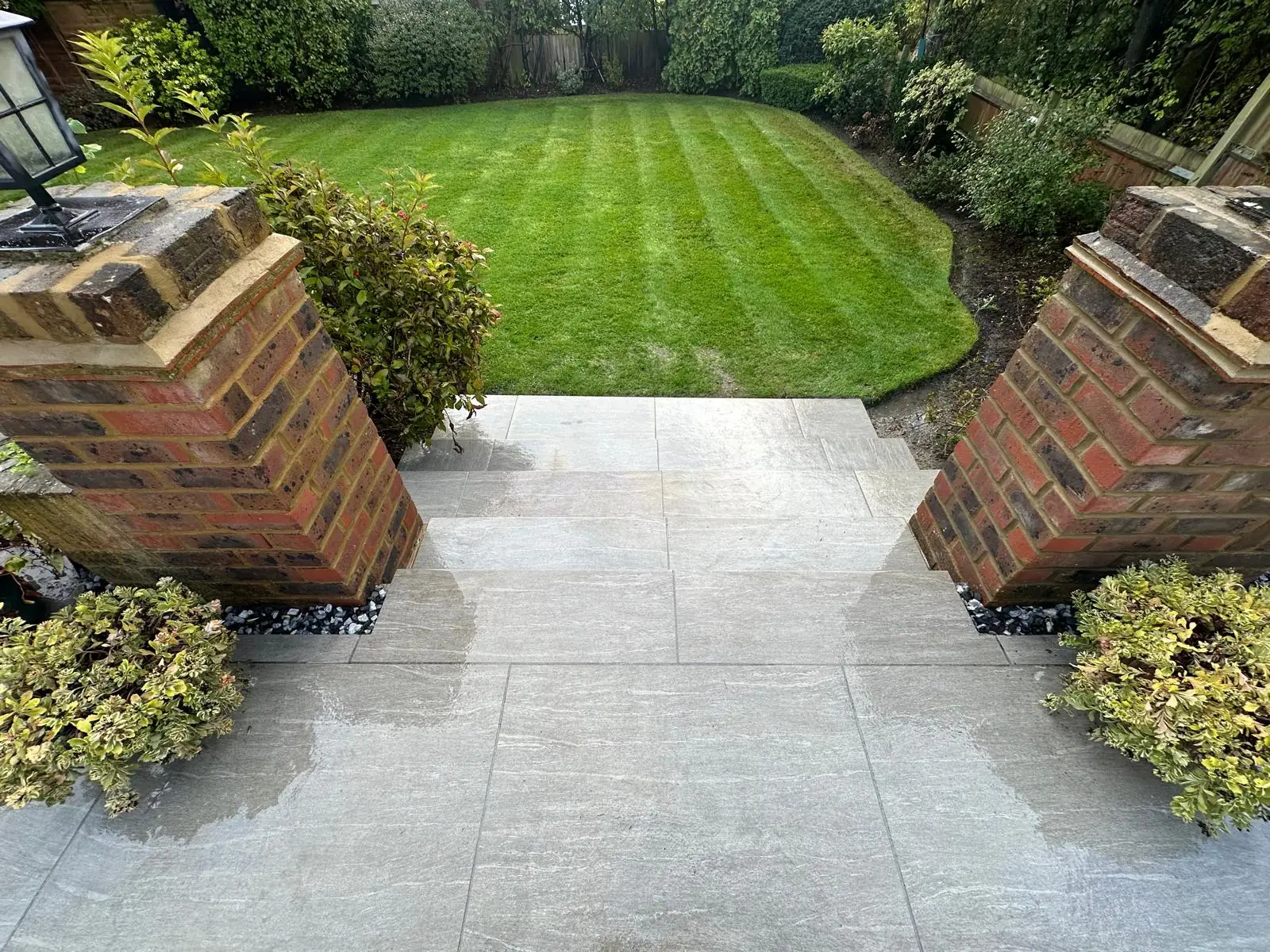
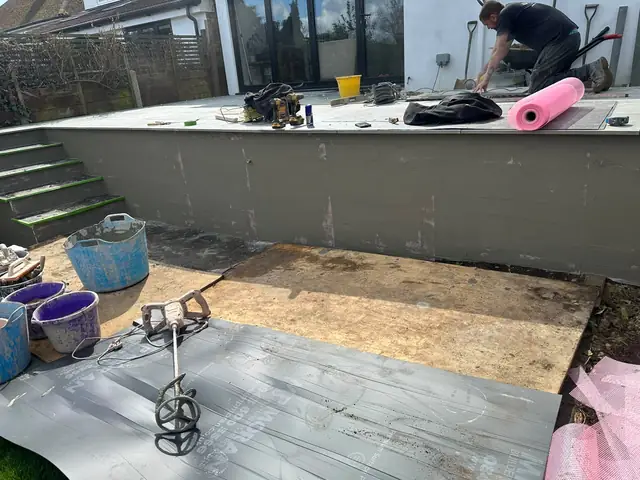
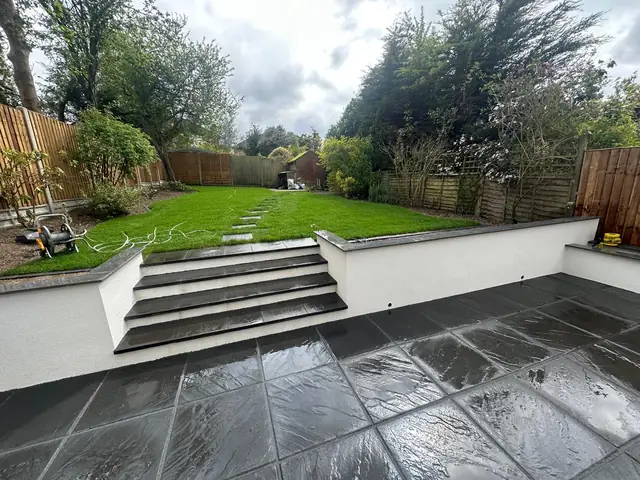
In Northwood, BMS Building took up an old slab terrace at the back of a house and replaced it with light grey porcelain, with porcelain steps down between the brick piers to the lawn and porcelain side paths running beside new close board fencing.
What Harrow properties are like
Two Harrow conditions decide a patio here. The first is London Clay. It shrinks and swells seasonally, so a patio bedded thin or laid on undisturbed clay moves within a few seasons, and the movement shows as cracked slabs and lifted edges regardless of what the slabs cost. The base is dug to what the ground shows and compacted in layers, and that is the part of a patio quote worth interrogating. Clay also holds water, so the falls have to take surface water somewhere it can genuinely go rather than to a border that is already saturated, and a patio that drains onto clay with nowhere to send the water simply moves the puddle. The second condition is the house. The inter-war stock is consistent enough that material choice is largely about what sits well against red brick and a bay frontage, and the damp proof course sits low enough that the finished level is constrained before the design starts.
Harrow questions
Will a patio move on clay?
- Only if it is built to. Clay shrinks and swells seasonally and anything shallow moves with it, so a patio bedded thin or laid on undisturbed clay will show it as cracked slabs and lifted edges within a few seasons, whatever the stone cost. A base dug to what the ground shows and compacted in layers takes that movement out. It is the part of a quote worth asking about.
Where does the water go on a clay garden?
- Somewhere it can actually leave, which has to be designed rather than assumed. Clay holds water, so falling a patio towards a border that is already saturated just moves the puddle. Depending on the garden that means a drainage run with an outfall, or a soakaway in ground that can take it, and it is worked out from what the dig finds.
Which material suits a 1930s house?
- There is more freedom than people expect, and it is mostly about tone against red brick rather than about the material itself. Porcelain is dense and low maintenance, Indian sandstone is warm and weathers, granite is the hardest wearing. The full comparison is on the patios page. What matters as much is the finished level, because the damp proof course on these houses sits low and constrains it.
We also cover Pinner, Northwood, Stanmore, Ruislip and Wealdstone from the same base.