
Paving in Harrow | Paths, Steps & Edging
BMS Building lays paving across Harrow and the areas around it: paths, steps, edging and terraces. On London Clay the build up under the paving matters more than usual, because clay that moves takes a thin base with it.
Covering Harrow
Paving in Harrow is usually a side passage, a path to a back door, or a terrace at the end of a long narrow garden, and the side passage is the first thing measured. It decides whether material can be barrowed round or has to come through the house, and on a lot of the inter-war stock it is narrow enough to matter. Where machinery cannot reach the back, the dig for a path or a terrace is done by hand and that is in the quote rather than added to it. Controlled parking zones cover parts of the borough, so where a delivery of slabs or a grab lorry stands and when is agreed with the property in advance rather than worked out on the morning. Harrow is about half an hour from Watford, where BMS is based, and is covered on the same round as Pinner, Northwood, Stanmore and Ruislip.
Paving in Harrow
Paving in Harrow has one condition that decides most of it, and it is under the slabs rather than on them.
BMS Building lays paths, steps, edging and terraces across Harrow, Pinner, Northwood, Stanmore and Ruislip, from a base in Watford about half an hour away.
London Clay
Clay shrinks in a dry summer and swells in a wet winter. Anything shallow moves with it.
A path laid straight onto the ground, or a terrace bedded thin, will show that within a few seasons as lifted edges and slabs cracked across the middle. It has nothing to do with the quality of the stone.
So the sub-base is dug to what the ground shows and compacted in layers, and nothing structural is laid on undisturbed clay and hoped for.
Clay holds water too
Which matters twice. The falls have to take surface water somewhere it can actually go, rather than to a border that is already saturated. And any step or retained edge needs drainage behind it so water is not building up against the back of it.
Full bed, not five blobs
Spot bedding puts a slab on five dabs of mortar and leaves most of its underside supported by nothing. Water gets under, frost works on it, the slab rocks or cracks.
A full mortar bed supports the whole slab. That is the method here.
The damp proof course
On the inter-war semis the DPC sits low. A path or terrace against the house has to finish clear below it, which constrains the finished level before the design starts.
The side passage
It is measured first, because it decides whether a machine can reach the back or whether the dig is done by hand. Where it is by hand, that is slower and dearer and it is in the quote.
Controlled parking zones cover parts of the borough, so where a delivery stands and when is agreed in advance.
Recent work near Harrow
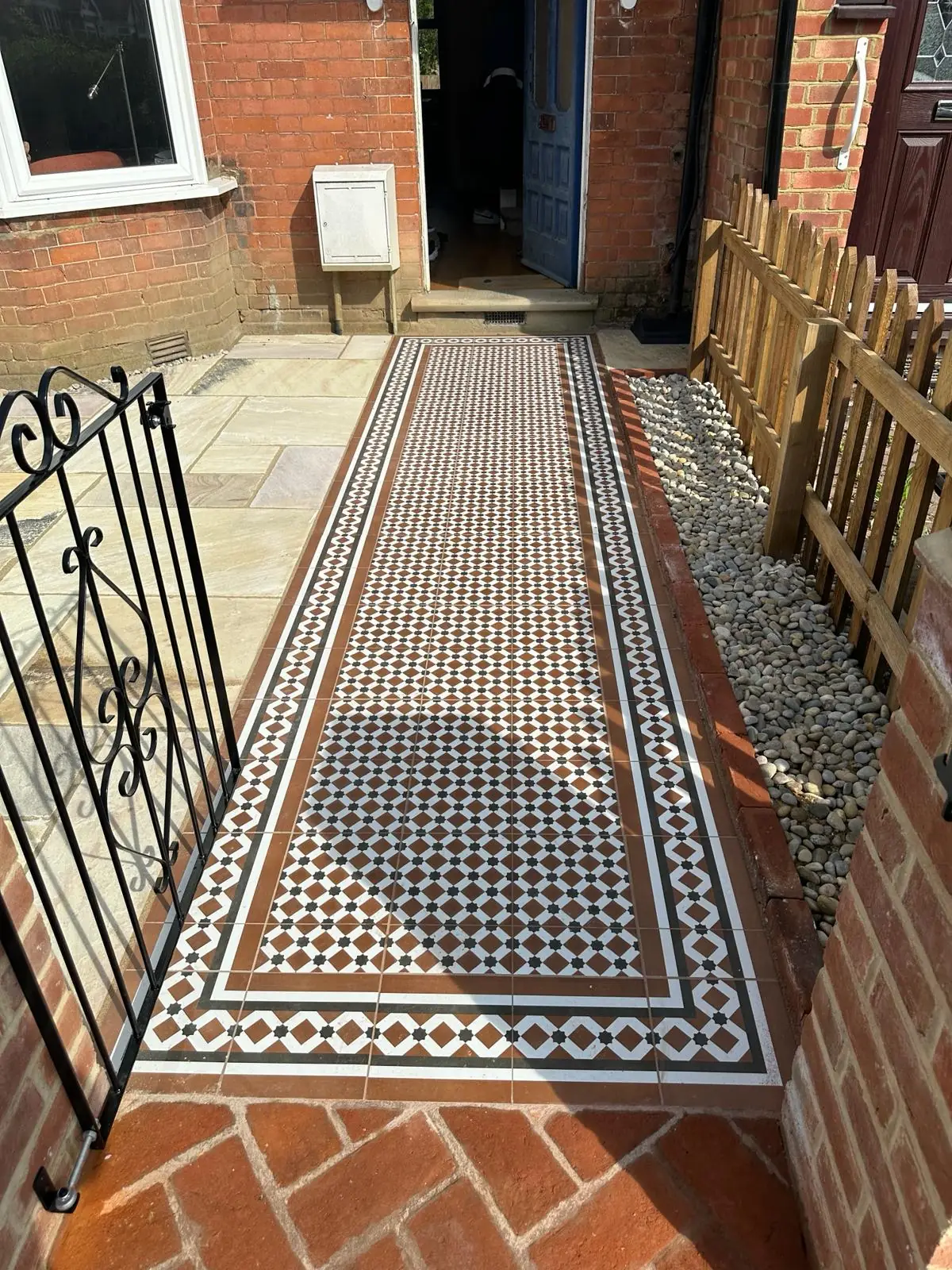
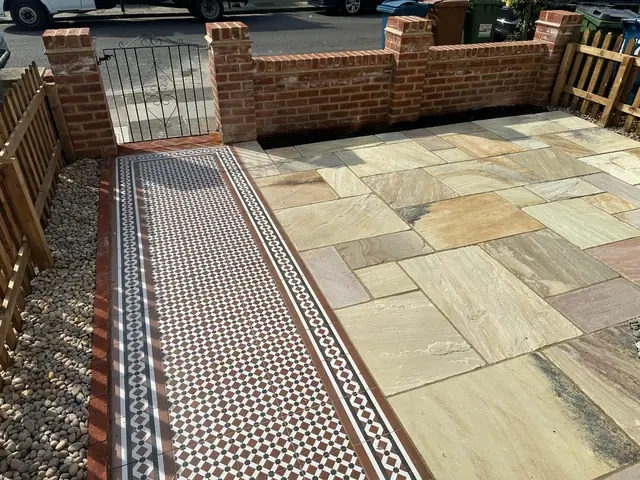
In Harrow, BMS Building laid a Victorian style mosaic tiled path from the front gate to the door, with 14 square metres of sandstone either side of it. The sandstone went down on mortar over a firm sub-base, laid with a fall away from the house so the water runs off, and was pointed with an epoxy jointing compound once it had set.
What Harrow properties are like
London Clay is what makes paving in Harrow different from paving in St Albans. Clay shrinks through a dry summer and swells through a wet winter, and that movement reaches anything shallow: a path laid straight onto the ground, or a terrace on a thin bed, will move within a few seasons and the movement shows as lifted edges and cracked slabs. So the sub-base is dug to what the ground shows and compacted in layers, and nothing is laid directly on undisturbed clay. Clay also holds water, which matters twice for paving: the falls have to take surface water somewhere it can actually go rather than to the nearest border that is already saturated, and any step or retained edge needs drainage behind it. The third local point is the damp proof course on the inter-war semis, which sits low enough that the finished level of a terrace or a path against the house is constrained before the design starts.
Harrow questions
Does clay mean paving will move whatever you do?
- No, it means the base has to be built for it. Clay shrinks and swells seasonally, so anything shallow moves with it. A properly dug sub-base compacted in layers takes that movement out of the finished surface. What does move is paving laid straight onto the ground or bedded thin, which is common.
What is spot bedding and do you do it?
- Spot bedding is laying a slab on five blobs of mortar instead of a full bed. We do not. It leaves most of the underside unsupported, water gets beneath it, and the slab rocks or cracks across the middle. A full mortar bed supports the whole slab and it is worth asking whoever else quotes whether they do the same.
My side passage is narrow. Can you still do the back garden?
- Yes. It changes the method rather than the answer. Where a machine will not fit, the dig is done by hand and material is barrowed, which is slower and dearer and is in the quote rather than discovered on day two. The passage is measured at the site visit for exactly that reason.
We also cover Pinner, Northwood, Stanmore, Ruislip and Wealdstone from the same base.